
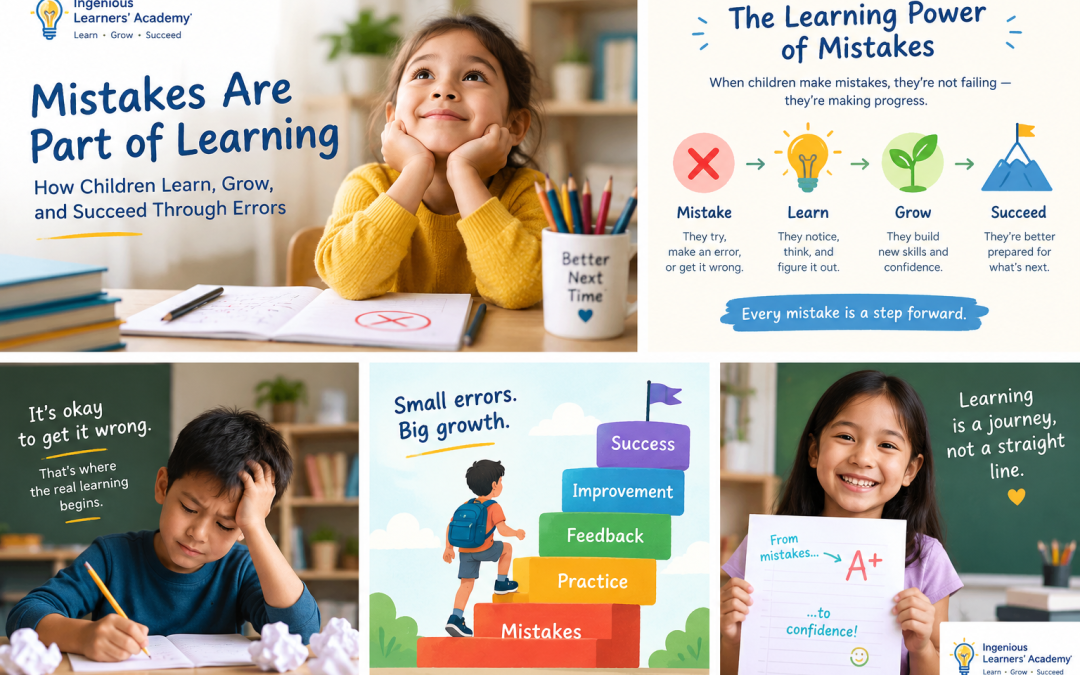
Introduction: Why Mistakes Are Part of Learning
A child learning something new will almost certainly make mistakes. Whether it is a young writer reversing letters, a student misapplying a formula during a math problem, or a reader mispronouncing complex words, errors are an inescapable milestone in child development.
Far from proving an inability to learn, mistakes are part of learning. Real learning occurs when a child attempts a task, evaluates the output, processes constructive feedback, adjusts their approach, and tries again.
When paired with proper instructional support, an incorrect answer becomes a diagnostic window into a child's understanding.
Modern research confirms this. A major 2025 review in the British Journal of Educational Psychology describes errors as important components of learning, emphasising that students need appropriate feedback, instructional support, and a supportive environment to benefit from them.
What Does "Mistakes Are Part of Learning" Really Mean?
Simply making a mistake does not guarantee automatic growth. A student can repeat the same error indefinitely without gaining insight. The educational value of an error depends entirely on what happens immediately afterward.
The Effective Learning Cycle
To turn an error into insight, guide children through a continuous feedback loop:
Attempt → Mistake → Feedback → Reflection → Correction → Mastery
| Traditional Approach (Low Impact) | Diagnostic Approach (High Impact) |
| "Wrong. The answer is 42." Provides zero insight into why the error occurred. | "Let's review your working together. What was your first step?" Helps the student spot their own calculation mistake. |
Why Do Children Make Mistakes?
Children rarely make errors out of carelessness alone. Identifying the underlying root cause helps educators and parents provide targeted support:
| Root Cause | What It Looks Like | Recommended Support |
| Conceptual Gaps | Misunderstanding core principles (e.g., place value, fractions) | Re-explain core concepts using concrete visual aids and manipulatives |
| Developmental Stage | Fine motor or cognitive skills still forming (letter reversal, uneven writing) | Provide targeted practice and patience; skills will mature |
| Strategy Errors | Applying an inefficient or incorrect method | Demonstrate alternative problem-solving techniques |
| Executive Load | Rushing, distraction, or misreading instructions | Encourage slow checking and step-by-step review |
Key Shift: From "Why did you get this wrong?" to "What does this mistake reveal about the learning process?"
Growth Mindset vs. Fixed Mindset in Education
How adults respond to errors shapes how children view their own potential. Research shows that a growth-oriented approach encourages children to see skills as qualities developed through practice and effective strategies.
| Fixed Mindset | Growth Mindset |
| "I cannot do mathematics." | "I cannot do this mathematics problem YET." |
Adding the word "yet" frames difficulty as a temporary state rather than a permanent limitation. However, a growth mindset must be backed by real instruction, structured practice, and quality educational resources — not just praise.
Subject-Specific Examples: Learning From Errors
1. Mathematics
Math offers clear feedback mechanisms. When a child calculates 46 + 27 = 63, pointing out the missing regrouping step teaches place-value mechanics far better than simply marking the answer red.
Learn more: Mathematics Tutoring programs at Ingenious Learners Academy [Internal Link]
2. Reading and Literacy
When a child mispronounces or skips a word while reading, avoid jumping in immediately. Prompt them with: "Look at that word again. What sound does the first blend make?" This reinforces decoding skills over passive guessing.
Explore: Reading Culture at Home [Internal Link]
3. Writing and Revision
Writing inherently requires iteration. Drafting, reviewing, and editing demonstrate to children that revision is not a punishment for mistakes, but a natural step toward clarity.
Discover: Reading and Literacy Support [Internal Link]
The 5-Step "Mistake-to-Learning" Framework
Teach children this practical framework whenever they run into an academic roadblock:
STOP: Take a deep breath to prevent frustration and emotional shutdown.
LOOK: Carefully review the problem and the initial attempt. Where exactly did it change?
THINK: Ask: "What strategy did I use? Why didn't it work? What can I try instead?"
CORRECT: Work through the specific step with new guidance and explicit correction.
RETRY: Apply the corrected method to a fresh, similar problem to build mastery.
What Parents Should Avoid Saying (And What to Say Instead)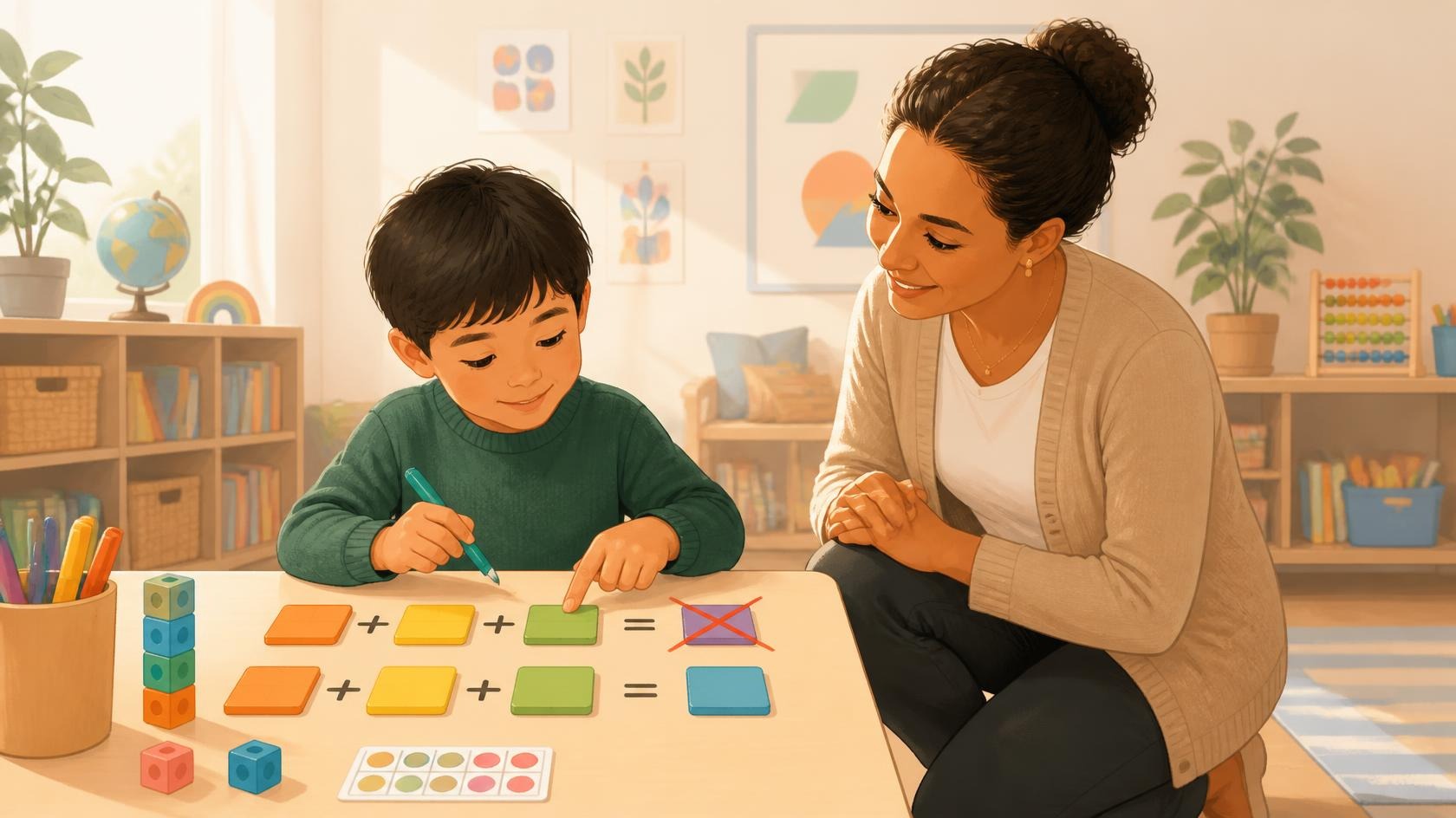
Unintentional language can make children fearful of taking academic risks.
| ❌ Avoid | ✅ Say Instead |
| "You always get this wrong." | "This concept is challenging right now. Let's practice it together." |
| "You should know this already." | "Let's review the steps to refresh your memory." |
| "Your classmates are better than you." | "Let's focus on your own progress. What did you improve?" |
| "This is easy. Why can't you do it?" | "It takes time to master new ideas. What part feels tricky?" |
| "Don't make mistakes." | "Mistakes help us see what we need to practice. Try your best." |
Building a Safe Learning Environment
Children learn best when they feel safe enough to participate. A safe environment does not mean low expectations — children should still complete work, correct mistakes, and take responsibility. The difference is that mistakes are handled constructively.
- A child should be able to say "I don't understand" without being mocked.
- A child should be able to ask "Can you explain it another way?" without embarrassment.
- A child should hear "Let's work out what happened" instead of "How could you get that wrong?"
From Mistakes to Mastery: A Practical Example
Imagine your child receives a math exercise with five incorrect answers. Instead of asking, "Why did you get five questions wrong?" try:
"Let's look at these five questions together. Do you notice anything similar about the mistakes?"
Perhaps all five involve multiplication. Now you have diagnostic information: the child needs additional support with multiplication, not a general lecture on effort. Review the concept, work one example together, let the child solve another independently, and celebrate improvement.
How Ingenious Learners Academy Helps Children Succeed
At Ingenious Learners Academy, we believe education goes beyond memorizing answers. Our personalized mentoring programs give children room to ask questions, work through complex challenges, and build lasting academic resilience.
- Diagnostic assessment to identify what a child already understands and where gaps occur
- Personalized instruction in Mathematics, English, Literacy, Reading, and Writing
- Feedback that teaches children how to detect, reflect on, and correct their own errors
- A supportive culture where children are not afraid to learn
Ready to boost your child's academic confidence? Explore our personalized Online Tutoring and Mentoring services today. [Internal Link CTA]
Frequently Asked Questions
Are mistakes really part of learning?
Yes. Mistakes provide crucial information about what a student understands and where support is needed. However, errors must be paired with reflection and feedback to create actual learning opportunities.
How should teachers handle student mistakes in class?
Encourage students to explain their reasoning, offer constructive feedback that identifies the exact error location, and provide immediate opportunities to apply corrections.
Should children be praised for making mistakes?
Children shouldn't be praised for the error itself, but rather for constructive behaviors like perseverance, checking work, asking for help, and seeking solutions.
Research References & Further Reading
1. British Journal of Educational Psychology — Learning from errors and failure in educational contexts (2025). Major review on contextual, motivational, and instructional factors including feedback and prompts.
2. Learning from errors in mathematics classrooms: Development over 2 years — Examines classroom error climate and student reactions to errors.
3. International Journal of STEM Education — Student reactions to errors and growth mindset — Explores relationship between growth mindset, error reactions, and study strategies.
4. Frontiers in Education — Impact of classroom error management climates (2026) — How classroom culture shapes learning from mistakes.
Final Thought: "It is okay to make a mistake. What matters is that you are willing to learn from it." Every mistake, when met with reflection and good teaching, can become a lesson.