
Introduction
Reading comprehension is far more than decoding words on a page, kids need to know these strategies — it is the gateway to understanding, critical thinking, and lifelong learning. Many students can read fluently, pronouncing words accurately and moving smoothly through text, yet they struggle to explain, analyze, or apply what they have read. This gap between word recognition and deep understanding defines reading comprehension, a foundational skill for academic success across every subject, from science experiments and history lessons to math word problems and literature analysis. www.readnaturally.com
For parents and students alike, strong reading comprehension is not a luxury but a necessity. In today’s information-rich world, the ability to extract meaning, connect ideas, and think critically determines not only school performance but also future opportunities. The encouraging reality is that reading comprehension is a teachable skill. With targeted reading comprehension strategies for kids, consistent practice, and supportive guidance, every child can become a confident, purposeful reader.
This comprehensive guide explores why reading comprehension matters, why many students face challenges, and practical, evidence-based strategies that parents and students can implement at home and in school. Whether you are a parent seeking to support your child or a student aiming to improve independently, these insights will equip you with tools for meaningful progress.
Understanding Reading as an Active Process
Traditional views often treat reading as passive absorption of information, like a sponge soaking up words. Modern educational research reveals a different truth: effective reading is an active, dynamic interaction between the reader and the text. Skilled readers do not merely see words—they engage their minds fully. www.readingrockets.org
- A proficient reader actively:
- Thinks critically about the author’s message, purpose, and potential biases.
- Asks questions before, during, and after reading to clarify and deepen understanding.
- Makes predictions about upcoming events or ideas based on clues and prior knowledge.
- Connects new information to what they already know, building richer mental frameworks.
- Monitors comprehension in real time, recognizing confusion and applying “fix-up” strategies like re-reading or summarizing.
- Visualizes scenes, concepts, or processes to make abstract ideas concrete.
This active approach transforms reading from a mechanical task into a purposeful conversation with the text. For students, adopting these habits builds confidence and independence. For parents, recognizing reading as active thinking helps shift focus from “Did you finish the chapter?” to “What did you think about it and why?”
Research from organizations like Reading Rockets emphasizes that teaching students to monitor their own comprehension—often called metacognition or “thinking about thinking”—is one of the most powerful ways to improve outcomes. When children learn to notice when they are lost and know how to recover, they gain control over their learning. www.readingrockets.org
Why Many Students Struggle with Reading Comprehension
Struggling with reading comprehension is common and rarely indicates low intelligence. It often stems from a combination of factors that can be addressed with targeted support. Parents and students benefit from understanding these root causes to avoid frustration and apply the right solutions. www.oxfordlearning.com
- Limited Vocabulary: Unknown words act as roadblocks. A single unfamiliar term in a science passage about photosynthesis, for instance, can derail understanding of the entire process. Without a robust vocabulary, even fluent readers miss nuances and main ideas.
- Complex Sentence Structures: Long, compound, or grammatically intricate sentences—common in textbooks and exam materials—can overwhelm learners, particularly English language learners or those still developing syntactic awareness.
- Lack of Background Knowledge: Comprehension relies heavily on what the reader already knows. A student with limited exposure to historical events or scientific concepts will struggle more with related texts than one who has built relevant schema through discussions, experiences, or wide reading. www.edweek.org
- Poor Reading Habits: Rushing through text without pausing, skipping difficult sections, or focusing solely on pronunciation rather than meaning reduces retention and understanding. Some students treat reading as a race rather than a thinking activity.
- Absence of Explicit Strategy Instruction: Many students are told to “just read” without learning how to read strategically. They lack tools for previewing, questioning, or summarizing, leaving them passive rather than active readers.
- Additional Factors: Attention challenges, working memory limitations, weak oral language skills, or insufficient phonics foundations in earlier years can compound difficulties. For some, decoding demands consume so much mental energy that little remains for comprehension. www.readingrockets.org
The good news? These challenges are not fixed traits. With awareness and deliberate practice of reading comprehension strategies for students, significant improvement is possible at any age..
Key Reading Strategies Every Student Should Master
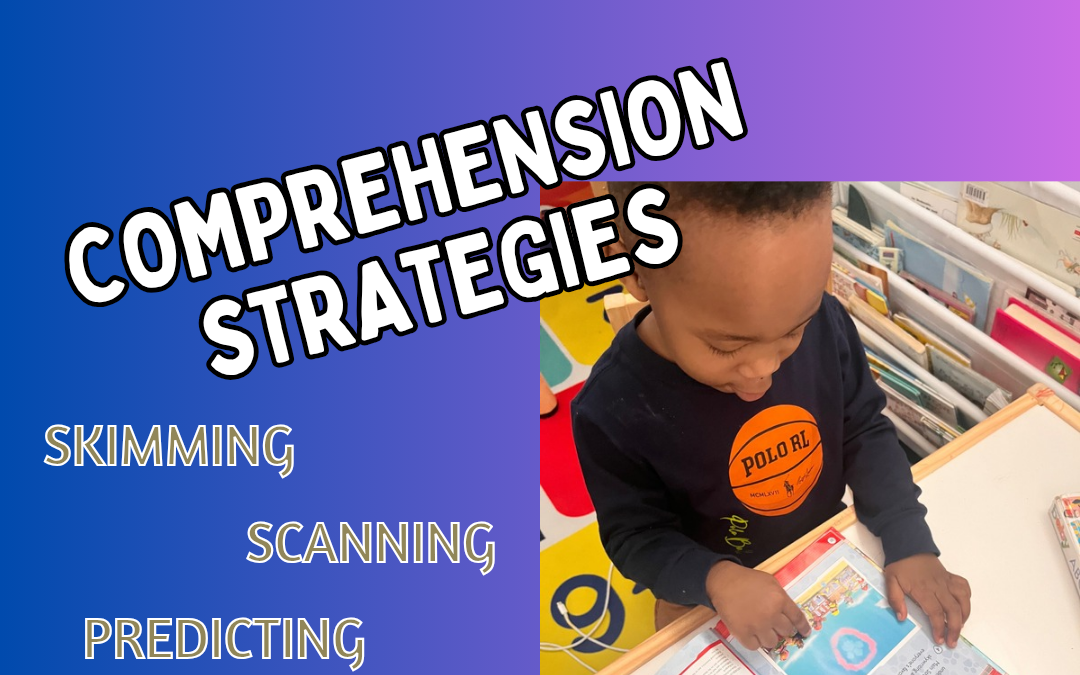
Effective readers use a toolkit of strategies flexibly. Three foundational techniques—skimming, scanning, and predicting—provide an excellent starting point for building confidence and efficiency.
Skimming: Grasping the Main Idea Quickly
Skimming involves quickly reviewing a text to understand its general topic, structure, and main ideas without reading every word. It is purposeful and selective, not careless.
How to Skim Effectively:
Read the title, subtitles, and headings.
Scan bold or italicized words, bullet points, and visuals.
Read the first (and sometimes last) sentence of each paragraph.
Review the introduction and conclusion.
Why Skimming Matters: It helps students decide whether a text is relevant, creates a mental roadmap before detailed reading, and saves time during research or exams. In a world of information overload, skimming prevents overwhelm and improves focus. www.butte.edu
Practical Example for Kids: Before diving into a lengthy social studies chapter on ancient civilizations, a student skims headings like “Daily Life in Egypt” and “The Role of the Nile.” This preview reveals the chapter’s focus, allowing better prediction and retention during full reading.
Common Mistake to Avoid: Treating skimming as speed-reading without purpose. True skimming is strategic—it targets structure and key signals while ignoring supporting details initially.
Parents can model this during shared reading: “Let’s skim the article first to see what it’s mostly about.” This simple habit builds efficiency for homework and tests.
Scanning: Locating Specific Information
Scanning is a targeted search for particular details—names, dates, numbers, definitions, or answers to specific questions—while ignoring irrelevant parts.
How to Scan:
- Clarify exactly what you are looking for (e.g., “the year the event happened” or “the definition of photosynthesis”).
- Run your eyes quickly down the page, focusing on keywords, numbers, proper nouns, or bold text.
- Stop only when relevant information appears.
Why Scanning Is Valuable: It is essential for answering comprehension questions efficiently, researching, and navigating real-world texts like schedules, menus, or instruction manuals. In timed tests, strong scanning skills reduce anxiety and improve accuracy. www.amle.org
Practical Example: When a question asks, “What was the main export of the region?” a student scans for keywords like “export,” “trade,” or specific product names rather than re-reading the entire passage. This technique turns a 10-minute task into a 30-second one.
Tip for Students: Practice with non-fiction materials first—newspapers, recipes, or timetables—where specific facts stand out clearly.
Predicting: Engaging the Mind by Thinking Ahead
Predicting involves using clues from the text, titles, images, and prior knowledge to anticipate what might happen next or what the author will discuss.
How Prediction Works:
- Before reading: Examine the cover, title, and illustrations.
- During reading: Use context clues and story developments to forecast outcomes.
- After sections: Adjust predictions based on new information.
Why Prediction Strengthens Comprehension: It keeps readers actively involved, boosts concentration, encourages critical thinking, and improves memory by creating expectations that the brain then confirms or revises. www.parentpowered.com
Practical Example for Students: Reading a story about a young explorer lost in the jungle, a child might predict: “I think she will find help from animals because she was kind to them earlier.” After finishing, reflect: “Was my prediction correct? What clues helped or misled me?”
Reflection Question: “What in the text makes me think this will happen?” This turns prediction into deeper analysis.
Parents can make prediction playful: “Based on the picture, what do you think will happen next?” This transforms bedtime stories into interactive thinking sessions.
A Simple, Effective Reading Routine for Home and School
Consistency beats intensity. A structured before-during-after reading routine helps students approach any text with purpose and reflection.
Before Reading: Activate and Prepare
- Preview title, headings, images, and bold text.
- Activate prior knowledge: “What do I already know about this topic?”
- Set a purpose: “Why am I reading this—to learn, enjoy, or find specific facts?”
- Make initial predictions.
This stage primes the brain, making new information easier to absorb and connect. www.readnaturally.com
During Reading: Stay Engaged and Monitor
Pause periodically to check understanding.
- Ask questions: “What does this mean? How does it connect to what I know?”
- Visualize scenes or concepts.
- Highlight key ideas or jot margin notes.
- Re-read confusing sections immediately.
- Adjust predictions as needed.
Techniques like think-alouds (verbalizing thoughts) are powerful for building metacognition.
After Reading: Consolidate and Reflect
- Summarize the main idea in your own words.
- Answer who, what, when, where, why, and how questions.
- Discuss or write about connections, inferences, and opinions.
- Evaluate predictions: What was accurate and why?
A quick retell in one’s own words is one of the best tests of true comprehension. If a child cannot explain it simply, more support is needed.
Parents and teachers can guide this routine gradually, starting with modeling (“I do”), moving to joint practice (“We do”), and finally independent application (“You do”).
Additional Powerful Strategies for Deeper Comprehension
Beyond the basics, students benefit from these research-supported techniques:
- Questioning: Generate and answer questions at all levels—literal, inferential, and evaluative.
- Clarifying: Stop to resolve confusion using context, dictionaries, or discussion.
- Summarizing: Condense key points, distinguishing main ideas from details.
- Visualizing: Create mental “mind movies” of descriptions to enhance memory and engagement. www.understood.org
- Making Inferences: “Reading between the lines” to understand implied meanings, character motivations, or author intent.
- Making Connections: Link text to self, other texts, and the world (text-to-self, text-to-text, text-to-world).
- Graphic Organizers: Use mind maps, story maps, or Venn diagrams to organize thoughts visually.
Practicing these strategies individually first, then combining them, leads to flexible, independent reading.
The Crucial Role of Parents in Building Reading Comprehension
Parents are a child’s first and most influential teachers. Research consistently shows that parental involvement in literacy activities significantly boosts vocabulary, comprehension, motivation, and attitudes toward reading. www.nwea.org
Practical Ways Parents Can Help:
- Create a Reading-Rich Environment: Stock accessible books, magazines, and digital resources matched to interests and reading levels. Designate a cozy, distraction-free reading spot.
- Model Positive Habits: Let children see you reading for pleasure and information. Talk about what you read and why it matters.
- Engage in Rich Conversations: Move beyond “What happened?” to open-ended questions: “Why do you think the character felt that way?” “How is this similar to something in real life?” “What would you have done differently?”
- Read Aloud Together: Even older children benefit from hearing fluent, expressive reading of more complex texts. Discuss predictions, inferences, and new vocabulary.
- Encourage Without Pressure: Praise effort and strategies (“I noticed how you went back to re-read that tricky part—that’s smart!”). Celebrate small wins to build confidence and reduce anxiety.
- Build Consistency: Aim for 15–30 minutes of daily reading or discussion. Short, regular sessions outperform occasional marathons.
- Support Diverse Materials: Include fiction, non-fiction, poetry, comics, and real-world texts to broaden background knowledge and vocabulary.
By fostering a supportive, enjoyable atmosphere, parents help children associate reading with curiosity and connection rather than obligation. www.neuhaus.org
When to Seek Guided Learning and Expert Support
While home support is powerful, some students benefit from structured, personalized instruction. Challenges like persistent vocabulary gaps, attention difficulties, or English as a second language may require targeted intervention.
- Professional literacy tutors can:
- Teach strategies step-by-step using the gradual release of responsibility model.
- Diagnose specific weaknesses and tailor support.
- Build vocabulary and background knowledge through engaging, interactive methods.
- Provide consistent feedback and progress monitoring.
At places like Ingenious Learners Academy, experienced literacy tutors deliver individualized programs that complement school efforts, helping students overcome obstacles and gain independence.
Long-Term Benefits and Lifelong Impact
Mastering reading comprehension does more than improve grades. It cultivates critical thinkers who can evaluate information, solve problems, empathize with others’ perspectives, and continue learning independently. In an era of rapid change and abundant information, these skills are essential for personal and professional success.
Students who read with understanding develop stronger writing, better communication, and greater confidence across subjects. Parents who invest time and encouragement witness not only academic gains but also a child who approaches learning with curiosity and resilience.
Conclusion: Every Child Can Become a Strong Reader
Reading comprehension is the bridge between decoding words and unlocking ideas. It is not an innate gift but a set of skills built through explicit teaching, active practice, reflection, and supportive relationships.
For students: Embrace strategies like skimming, scanning, predicting, questioning, visualizing, and summarizing. Approach every text with curiosity and a willingness to think deeply.
For parents: Your involvement—through modeling, conversation, consistent routines, and gentle encouragement—makes a profound difference. Create joy around reading and provide the tools and time for practice.
With patience, the right reading comprehension strategies for kids, and appropriate guidance when needed, every child can develop into a confident reader, critical thinker, and independent learner. The journey requires effort, but the rewards—academic achievement, lifelong curiosity, and empowered minds—last a lifetime.
Ready to help your child build stronger reading skills and lasting confidence? Visit www.ingeniouslearners.com or book a session with expert tutors today. Small, consistent steps at home, combined with targeted support, can transform your child’s reading journey.
References and Further Reading: