
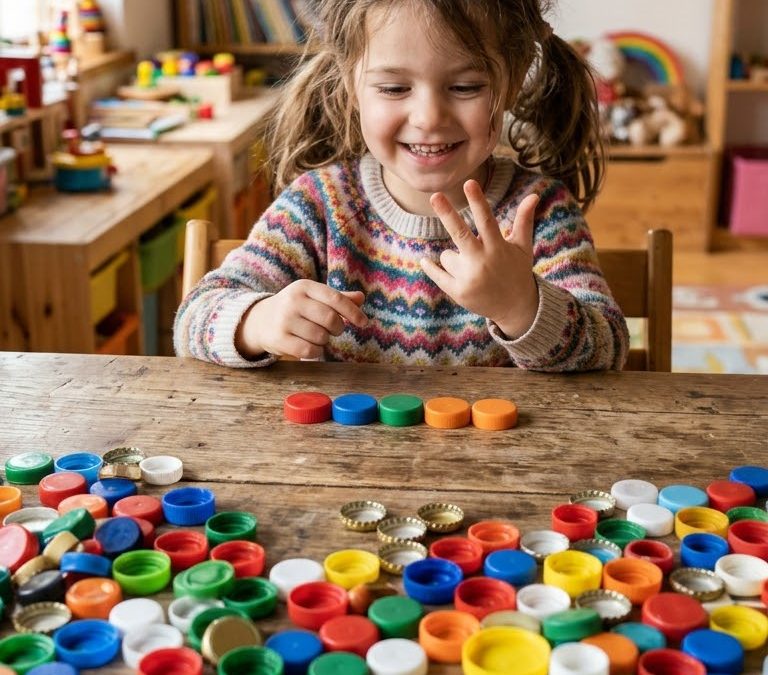
Why Does My Child Count on Their Fingers? (And Why They Shouldn’t Stop Yet)
Picture this. Your seven-year-old is at the dining table with her homework. The question is simple: 6 + 3. Her eyes drift down to her hands. One finger pops up, then another, her lips move silently, and finally she announces, “Nine!” You feel a small knot of worry. Shouldn’t she just know that by now? Is finger counting a problem, and should you tell her to stop?
If this sounds familiar, you are in very good company. Many parents wonder whether finger counting means a child is “behind” in mathematics. At Ingenious Learners Academy, we hear this question more than almost any other, and our answer is always the same: please do not rush to stop it. Finger counting is not a weakness. Instead, it is one of the most natural and well-researched stepping stones in learning to think mathematically.
In this article we explain why children count on their fingers, what happens in the brain, the stages on the way to mental calculation, the myths that cause needless stress, and practical, low-cost ways to guide your child towards confident mental strategies. You need patience, a few bottle caps and a little curiosity.
In a nutshell: Counting on fingers is normal, healthy and helpful for children aged 5 to 8. The goal is not to ban the fingers but to help the child use them more cleverly until the number facts are secure.
1. First, the Good News: Finger Counting Is Completely Normal
Across many cultures, people have used their fingers to represent numbers, and finger counting is often one of the first ways children link a number word to a quantity (Berteletti and Booth, 2015). Our decimal system is widely believed to have grown out of our ten fingers.
When a child starts school, she must move from real things (three oranges, five steps to the gate) to abstract symbols (3, 5, +, =). A “7” is just a squiggle until she understands that it stands for a quantity, the same whether it is seven mangoes or seven pencils. Fingers are therefore the perfect bridge: always available, visible and easy to move. A child counting on her fingers is not avoiding thinking. She is thinking with her body, which is how young minds learn best.
2. What Really Happens in the Brain During Finger Counting?
Scientists who study early mathematics have taken a keen interest in fingers. So here are the key ideas.
Fingers connect quantity to symbols
Every number has three “faces”: the quantity (how many), the word (“seven”) and the symbol (7). Real understanding therefore links all three. A child who raises seven fingers while saying “seven” and looking at the numeral 7 joins them in one experience of seeing, touching, saying and moving.
Fingers and “finger sense”
“Finger sense” (or finger gnosis) is the ability to tell fingers apart without looking. Studies find that young children with good finger sense tend to do better in early number work, and one preschool study found the link strongest in the youngest children (Sánchez and colleagues, 2021). Brain imaging adds a twist: when children aged 8 to 13 solved subtractions, the brain area representing the fingers became active even though they were not using them (Berteletti and Booth, 2015). Jo Boaler of Stanford University has drawn on this research to argue that schools should stop discouraging finger use (read her article).
To be fair, cause and effect are not settled. A kindergarten training study found that a finger-based number programme did not raise arithmetic skills beyond a comparison activity (Schild and colleagues, 2020), and the link between finger sense and maths seems to fade as children grow older. A sensible reading is that fingers are a helpful stage for young learners: not a magic cure, and not a permanent crutch.
Fingers reduce mental overload
Working memory, the mind’s small workspace, is limited in young children. To solve 8 + 5 in her head, she must hold the 8, the 5, her count so far and her starting point. Fingers act like a notepad, leaving more room to think. (This is our plain-language picture, not one study’s finding.)
Fingers help children see structure
Our hands offer a built-in pattern: two hands of five. Thus a child who sees seven as “five and two” is beginning to understand that numbers can be broken up and put together, the foundation of mental arithmetic, fractions and, later, algebra.
3. The Journey From Finger Counting to Fluent Mental Maths
Children do not wake up one morning knowing their addition facts. Instead, they move through recognisable stages, each at her own pace. Education researchers describe a similar progression: modelling and counting, then reasoning from known facts, then efficient recall (Everyday Mathematics literature review; Ginsburg, Stanford).
Stage 1: Finger counting everything from one
For 4 + 3, the child holds up four fingers, then three, then counts them all: “One, two, three, four, five, six, seven.” It is slow, but it shows she understands that adding means putting groups together. A US Institute of Education Sciences toolkit notes that most children can solve small sums this way by age 5, and almost all by age 6 (IES toolkit).
Stage 2: Counting on
Soon she discovers a shortcut: say the bigger number and count on. “Four… five, six, seven.” This shows she understands that “four” already contains four. It signals growing maturity rather than laziness. Children are ready when they can start counting from anywhere in the number sequence (IES toolkit).
Stage 3: Using known facts and number bonds
Gradually she remembers some facts without counting: doubles (3 + 3), pairs that make ten (7 + 3), and “one more” or “one less” than a known fact. “I know 5 + 5 is 10, so 5 + 6 must be 11.” Fingers are now used mainly for checking. Researchers call these derived facts, and many rest on doubles and combinations of ten (Everyday Mathematics literature review).
Stage 4: Instant recall
After plenty of meaningful practice, facts become automatic. She simply knows that 6 + 3 = 9, like her own name. Adults, however, often expect this far too early. It arrives gradually over the first years of school, most securely when earlier stages are not skipped.
Key point: Each stage builds on the one before. If a child is pushed to “just remember” facts before she understands them, she may memorise a few answers but struggle when the numbers get bigger.
4. Five Common Myths About Finger Counting
Myth 1: “Finger counting means my child is slow at maths.”
Not true. Instead, it is a normal stage that nearly all children pass through. Speed of recall is only a small part of mathematical ability; understanding and reasoning matter far more.
Myth 2: “If I let her use her fingers, she will never stop.”
Most children drop finger counting naturally once they have better strategies and more confidence. Nobody sits in a lecture hall counting on their fingers for 4 + 5. Children stop when they no longer need them, like stabilisers on a bicycle.
Myth 3: “Finger counting is cheating.”
Still, using fingers is using a tool. We would not say a carpenter cheats by using a tape measure.
Myth 4: “Fast children never use their fingers.”
Some children simply hide their fingers under the desk, and others developed mental strategies earlier through practice at home. However, comparing children is rarely helpful.
Myth 5: “Flash cards and chanting are the best way to get rid of fingers.”
Memorisation has its place, but on its own it is a fragile foundation. A child who has learnt “7 + 8 = 15” as a sound pattern is lost the moment she forgets it. The best approach combines understanding with practice. See our guide to learning multiplication tables without tears.
5. When Is Finger Counting Fine, and When Should You Look Closer?
Finger counting is expected and healthy from about 4 to 8 years old. These signs show that everything is on track:
- She counts on rather than counting everything from one.
- Her explanations are clear (“I started at 6 and counted three more”).
- She is slowly getting faster and more accurate over several months.
- She sometimes simply knows an answer, such as doubles or pairs that make 10.
- Overall, she is happy and confident, even when she makes mistakes.
It may be worth a quiet word with her teacher or an experienced tutor if you notice the following over a long period:
- A child of 8 or 9 who still counts in ones from one, even for sums such as 3 + 2.
- Frequent counting errors, such as skipping fingers or losing track.
- Strong anxiety, tears or avoidance whenever numbers appear.
- Difficulty recognising small groups, such as dice dots, without counting each one.
- No visible progress over many months despite regular practice.
These signs are not a diagnosis, because often a child simply needs more hands-on practice or a little more time.
We mention ages 8 and 9 for a reason, since a research summary from Number Sense Maths reports that children rated below average at about age 8 still used “count all” or “count on” almost exclusively, while above-average children mostly used known and derived facts. Heavy dependence on fingers is also sometimes seen in children who find maths hard (Hilton, 2018). So we do not ban fingers; we guide children towards better strategies. For more on derived-fact strategies, see Dowker, 2014.
6. How to Gently Move From Finger Counting to Mental Strategies
The aim is not to take the fingers away but to give your child smarter strategies, so she reaches for her fingers less often because she has something better. Here are seven steps for home.
Step 1: Teach “smart fingers” instead of “counting fingers”
Show your child numbers on her hands as patterns rather than counts. Seven is a full hand and two more; eight is a hand and three; nine is ten with one finger down. When she can flash a number instantly, she is moving from counting to recognising.
Try a game: call a number from 1 to 10 for her to show quickly, then reverse it.
Step 2: Practise “counting on” properly
First, help her start from the bigger number. For 3 + 6, start at 6 and count on three (“six… seven, eight, nine”). A number line on paper, or chalked on the ground, lets her hop along it. Fewer counts therefore mean fewer mistakes.
Step 3: Build a “friendly numbers” toolkit
Some numbers are friendlier than others, so help her learn these well, because they unlock many other facts:
- Doubles: 1 + 1, 2 + 2, up to 10 + 10.
- Pairs that make 10: 1 and 9, 2 and 8, 3 and 7, 4 and 6, 5 and 5.
- One more, one less: if 5 + 5 = 10, then 5 + 6 is one more.
- Near doubles: 6 + 7 is the double of 6 with one extra.
Step 4: Introduce “make ten”
For 8 + 5, show that 8 needs 2 more to make 10. She takes 2 from the 5, leaving 3, so 8 + 5 is 10 + 3, which is 13. This is perhaps the most powerful mental strategy in early arithmetic, and the reason that understanding place value (the subject of our next article) matters so much. Practise first with real objects, such as two trays of ten bottle caps. Making-ten strategies promote fluency and support later multi-digit calculation (Everyday Mathematics literature review).
Step 5: Play, play and play again
Short, happy practice beats long, tense homework. Five to ten minutes a day is better than an hour on Sunday evening. Also, games build fluency without pressure.
Step 6: Ask “How did you work it out?”
This one question tells your child that her thinking matters more than the answer. It shows you which stage she is at, and putting a strategy into words strengthens it. Right or wrong, respond with curiosity: “Tell me how you got that.”
Step 7: Let finger counting fade on its own
Do not set a deadline. Instead, as her strategies improve, she will use her fingers a little less each week. Praise the smart strategy (“I love how you started from the bigger number!”), not the disappearance of the fingers.
7. Fun, Low-Cost Activities You Can Do at Home Using Everyday Things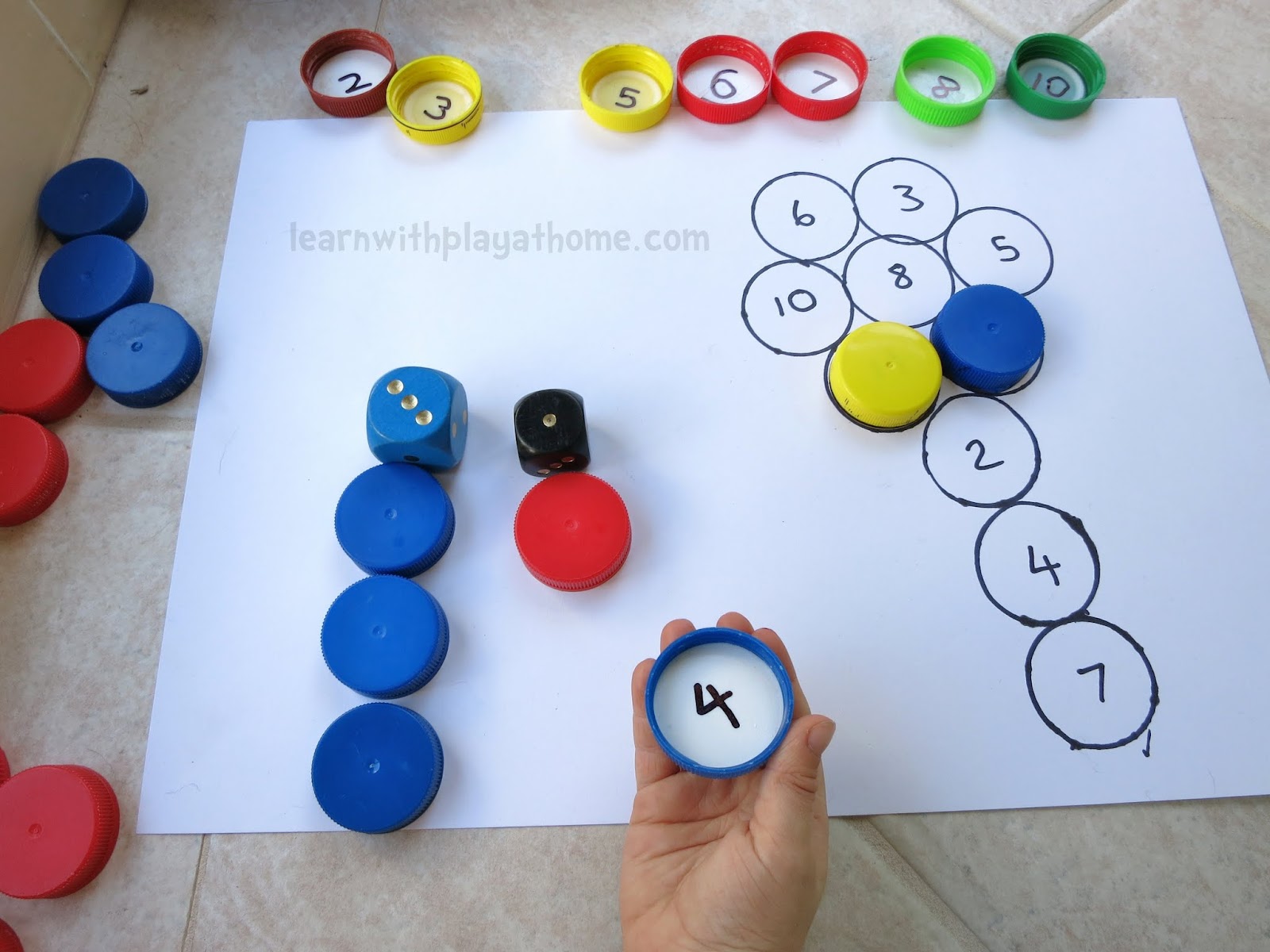
You do not need expensive toys or apps, because almost everything a child needs can be found in a Nigerian home or compound.
Bottle-cap bundles
Collect about fifty bottle caps and some rubber bands or string. Ask your child to tie caps in groups of ten, a concrete way to see that ten ones make one ten. Then build numbers (“Show me 23”: two bundles and three loose caps) and use them to add and subtract.
The market game
Set up a pretend shop with tins of tomato, sachets of milk, small stones as “coins” and paper price tags. Take turns as shopkeeper and customer: “These three oranges cost 2 coins each… how many coins do I need?” It links mathematics to real life as no worksheet can. For more story-based ideas, see turning word problems into real-life games.
Groundnut or stone sharing
Give her ten groundnuts or stones and two plates, and ask her to share them in as many ways as she can: 10 and 0, 9 and 1, 8 and 2. Thus she is discovering number bonds through play.
Ayo and board games
Ayo (Oware), Ludo and Snakes and Ladders all involve counting, comparing and planning. In particular, Ayo needs quick counting of seeds as they are sown, which is wonderful practice for counting on.
Everyday counting conversations
Count the stairs, the plates at dinner, the cars at the junction, and ask questions as you go. Since these chats cost nothing, they build number sense daily.
8. A Word to Teachers and Schools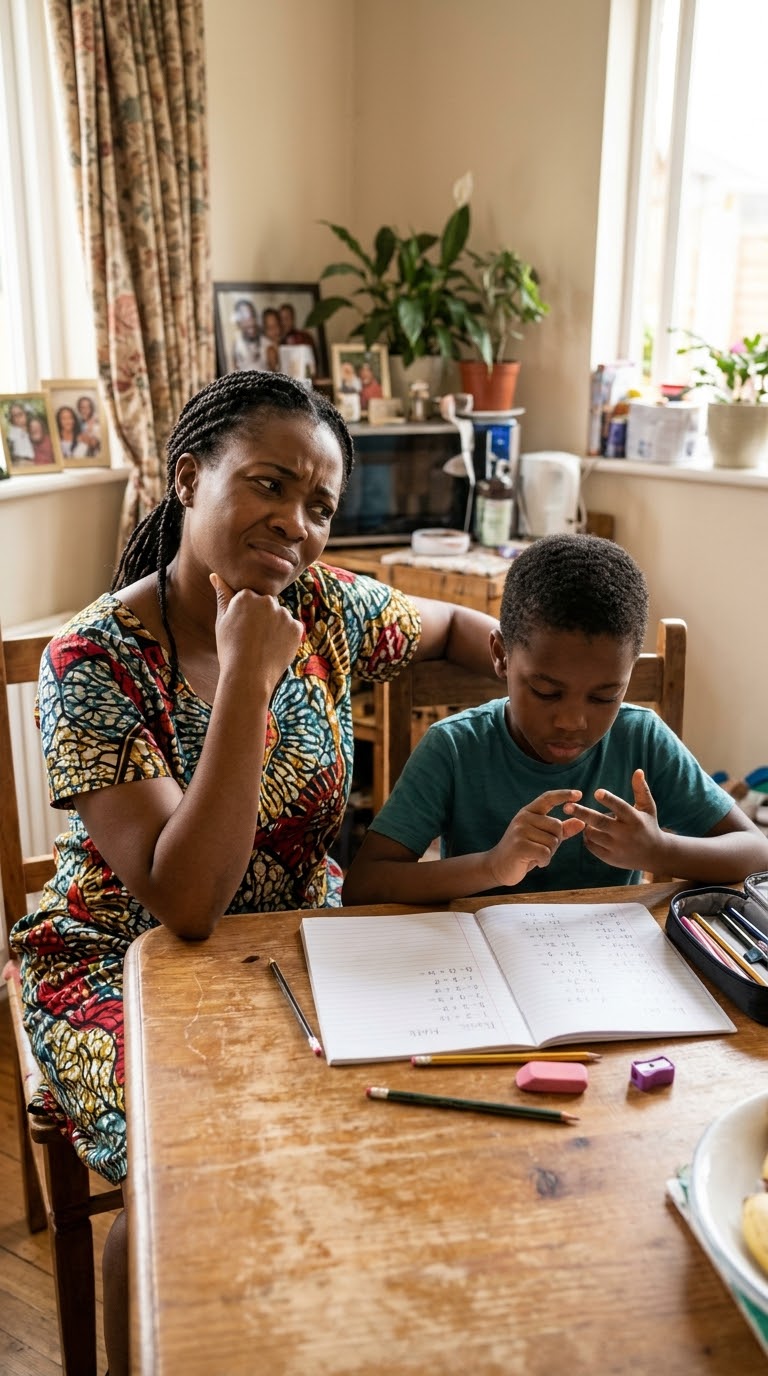
If you teach young children, treat finger counting as valuable assessment information: it shows whether a child is counting everything, counting on, or using known facts. Rather than banning fingers, consider the following:
- Teach efficient finger use through patterns of five.
- Keep manipulatives (counters, beads, ten frames) available to all children, not only those who struggle.
- Ask children to explain their methods and celebrate strategies, not only correct answers.
- Avoid timed tests for number facts in the early years; they raise anxiety.
9. Mistakes Parents Often Make (and What to Do Instead)
- Saying “Don’t use your fingers!” The child feels ashamed and hides them. Say instead, “Great, now let’s find a quicker way.”
- Comparing with siblings or neighbours’ children. Instead, compare your child only with where she was last month.
- Over-relying on rote chanting. Instead, pair it with understanding and real objects.
- Turning homework into a battle. If frustration builds, take a break and play a game instead.
- Giving the answer too quickly. Wait a few seconds and ask, “What could you try first?”
- Letting your own maths anxiety show. “I was never good at maths either” can tell a child that struggling is inevitable. Try, “This is tricky, let’s work it out together.”
10. Finger Counting: Frequently Asked Questions
At what age should my child stop finger counting?
There is no single age. Most children use their fingers heavily between 5 and 7, less between 7 and 9, and rarely after that for simple facts. If your child is 8 or 9 and still counts everything from one for simple sums, discuss it with a teacher.
Is it a problem if finger counting happens under the table?
Not necessarily. It may mean she feels embarrassed, so talk openly. Tell her that fingers are a clever tool and that many grown-ups use their hands to think.
My child gets answers right but only through finger counting. Should I worry?
Not at this stage, because accuracy comes first and speed comes later. Help her use efficient strategies such as counting on and making ten, and slowly add games that build quick recall.
My child seems to hate maths already. What can I do?
Start with fun and no pressure: games, number stories, and praise for effort rather than only correct answers. If the dislike is strong or lasting, a patient tutor can make a big difference. Our article on maths anxiety looks at this in more depth.
11. Key Takeaways
- Finger counting is normal, natural and helpful for children aged 5 to 8.
- Fingers link quantity, number word and written symbol, and reduce mental load.
- Children move from counting all, to counting on, to known facts, to instant recall.
- Never shame a child for using her fingers; teach her smarter ways to use them.
- Games, real objects and conversation build number sense better than drilling.
- Ask “How did you work it out?” often. The thinking matters more than the answer.
Conclusion: Trust the Process, and Keep It Joyful
The next time you see your child quietly counting on her fingers beneath the dining table, we hope you will smile rather than worry. Behind those small moving fingers is a growing mind building one of the most important skills she will ever learn: making sense of numbers. Fingers are not a sign that she is behind; instead, they are a sign that she is thinking.
Your role is not to take the fingers away but to walk beside her as she discovers smarter ways of working with numbers. Give her time, games and encouragement, and one day her hands will rest quietly in her lap while the answer arrives in her head.
In our next article, we look at another cornerstone of early mathematics: place value, and why “13” is so much more than a “1” and a “3”.
How Ingenious Learners Academy Can Help
At Ingenious Learners Academy, we believe every child can enjoy mathematics and succeed in it. Our teachers use hands-on methods, games and patient, individual attention to build strong number sense from the start.
Would you like to see how your child is doing? Contact us today to book a friendly, no-pressure assessment. You can also explore our maths programmes or enrol your child online.
Join the conversation: Did your child count on her fingers? What strategies worked for you? Share your experience in the comments below.
References and Further Reading
The research points in this article come from the sources below. Please note that most of the studies describe associations between finger skills and maths, not proof of cause and effect. The practical home activities (bottle caps, the market game, Ayo, hopscotch and so on) are suggestions drawn from general classroom practice and are not claims from these studies.
- Berteletti, I. and Booth, J. R. (2015). Perceiving fingers in single-digit arithmetic problems. Frontiers in Psychology, 6:226. https://www.frontiersin.org/journals/psychology/articles/10.3389/fpsyg.2015.00226
- Boaler, J. Article on finger perception and maths learning, Stanford Graduate School of Education. https://ed.stanford.edu/node/9070
- Schild, U. and colleagues (2020). Finger-Based Numerical Training in Kindergarteners. Frontiers in Psychology, 11:529. https://www.frontiersin.org/articles/10.3389/fpsyg.2020.00529/pdf
- Sánchez, R., Orrantia, J., Matilla, L. and Múnez, D. (2021). Cognitive correlates of early math abilities and finger gnosis. Paper presented at the 19th Biennial Meeting of the European Association for Research on Learning and Instruction (EARLI). https://produccioncientifica.usal.es/documentos/61dee1fe030b121432302dbc?lang=en
- Hilton, C. (2018). The role of finger gnosis in the development of early number skills. Proceedings of the 42nd Conference of the International Group for the Psychology of Mathematics Education, Umeå, Sweden. https://discovery.ucl.ac.uk/id/eprint/10053438/
- Hilton, C. The mathematical development of children with Apert syndrome (doctoral thesis, UCL Institute of Education). https://discovery.ucl.ac.uk/id/eprint/1568129/
- Institute of Education Sciences (US). Teaching Math to Young Children Toolkit: Module 4, Solving Basic Problems, Developmental Progression. https://ies.ed.gov/ncee/rel/math-young-children/pdf/TMYC_Mod4_Solving_Basic_Problems_Developmental_Progression.pdf
- Institute of Education Sciences (US). Teaching Math to Young Children Toolkit: Glossary. https://ies.ed.gov/ncee/rel/math-young-children/pdf/TMYC_Glossary.pdf
- Everyday Mathematics 4: Review of the literature for the facts strand (McGraw Hill). https://www.mheducation.com/unitas/school/explore/research/em-review-literature-for-facts-strand.pdf
- Ginsburg, H. P. Ben Learns How to Add. Stanford Pre-K Mathematics. https://prek-math-te.stanford.edu/node/136
- Number Sense Maths. Research Principle 2: Children benefit from moving beyond counting in ones. https://numbersensemaths.com/research-principles/research-principle-2
- Dowker, A. (2014). Young children’s use of derived fact strategies for addition and subtraction. Frontiers in Human Neuroscience, 7:924. Hosted copy: https://numbersensemaths.com/media/2329/dowker.pdf